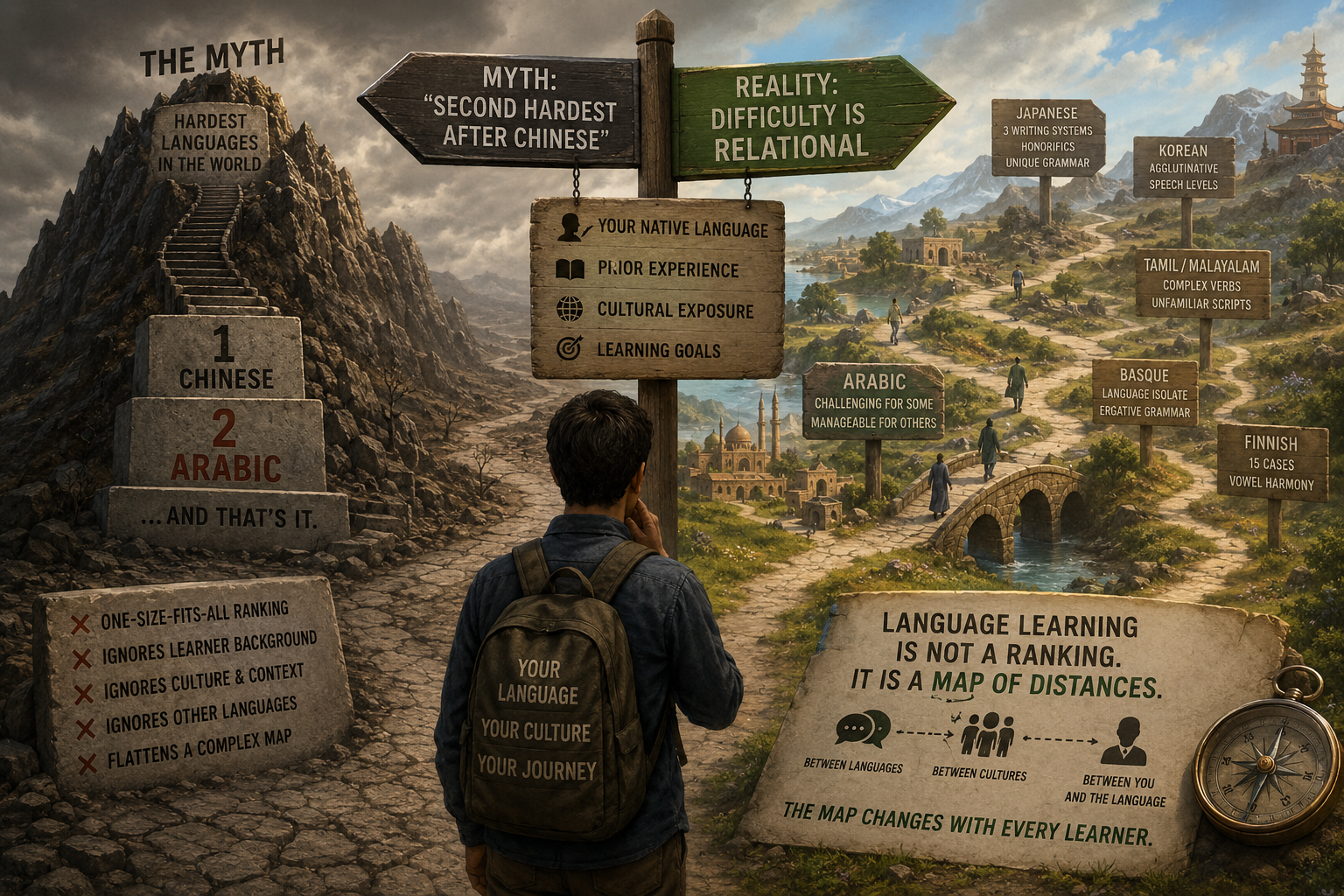
It has become a kind of folk wisdom, repeated in language-learning forums, travel blogs, and even some academic circles: Arabic is the second hardest language in the world to learn, right after Chinese. It sounds authoritative. It gets nodded along to. And it is, quite simply, wrong — not because Arabic is easy, but because the claim rests on a category error about what “difficulty” even means.
Difficulty Is Not a Property of a Language
A language does not carry a fixed difficulty score the way a mountain carries a fixed elevation. Difficulty is a relationship between two things: the language being learned and the language(s) already in the learner’s head. A Hebrew speaker encountering Arabic’s root-and-pattern morphology already has a mental scaffold for it. A Persian or Urdu speaker recognizes a huge slice of Arabic vocabulary on sight, borrowed centuries ago through religion, trade, and scholarship. For these learners, Arabic is demanding but not alien. For a monolingual English speaker with no exposure to Semitic languages, Arabic script, guttural consonants, and a root system built on three-letter skeletons will indeed feel like starting from zero. Same language, two completely different learning curves — determined not by Arabic, but by the learner’s starting point.
This is precisely why institutions like the U.S. Foreign Service Institute rank Arabic in their hardest category for English speakers specifically. That ranking is a statement about linguistic distance from English. It was never meant to be a universal verdict on Arabic itself, and treating it as one is a misreading of the data.
Culture Is Part of the Equation, Too
Language difficulty is never purely structural. Learning Arabic also means learning to navigate diglossia — the gap between the Modern Standard Arabic of the news and the dozen-plus spoken dialects of everyday life. That gap is not like the distance between Italian and Portuguese; it is closer to the distance between British, American, and Australian English, or between the English of London and the English of Liverpool — variations on a shared core rather than separate languages. The crucial difference is that English varieties are used for everything: news, literature, law, business, government. Arabic’s spoken dialects are almost exclusively street language, confined to daily conversation, while Modern Standard Arabic remains the language of writing, media, and formal life. A learner has to master both registers, and know when each one applies, in a way an English learner never has to. It means absorbing register, politeness conventions, and a literary and religious tradition that shapes idiom and metaphor. A learner who has already spent time inside Islamic or Middle Eastern cultural contexts — through family, travel, or prior study — carries a head start that a learner arriving cold does not have. Difficulty, again, is relational, not intrinsic.
The Claim Ignores an Entire Tier of Languages
Whoever popularized “second hardest after Chinese” clearly never sat down with Japanese, which combines three writing systems, an honorific system tied to social hierarchy, and a grammar structure almost unrelated to European languages. They never tried Korean, whose agglutinative grammar and speech-level system present a completely different kind of complexity. They never attempted Tamil or Malayalam, Dravidian languages with elaborate verb morphology and script systems that most Western learners have never seen a single letter of. They never wrestled with Basque, a language isolate with no known relatives, whose ergative grammar breaks every assumption an Indo-European speaker brings to the table. And they certainly never took on Finnish, with its fifteen grammatical cases and vowel harmony rules that reshape entire word chains.
Each of these languages produces its own version of the “hardest language” experience, for its own set of learners, for its own structural reasons. The existence of a tidy top-two list — Chinese, then Arabic — says more about which languages happen to be popular in Western language-learning discourse than about actual comparative difficulty.
What Should Replace the Myth
A more honest statement would be: Arabic is significantly challenging for speakers of languages structurally and culturally distant from it, particularly Indo-European languages with Latin scripts, and comparably manageable for speakers of related or historically connected languages. That is a less quotable sentence than “second hardest after Chinese.” It is also the true one.
Difficulty in language learning is not a ranking. It is a map of distances — between one language and another, between one culture and another, between one learner’s history and the language ahead of them. Reducing that map to a two-item leaderboard flatters the storyteller’s certainty far more than it informs the learner.