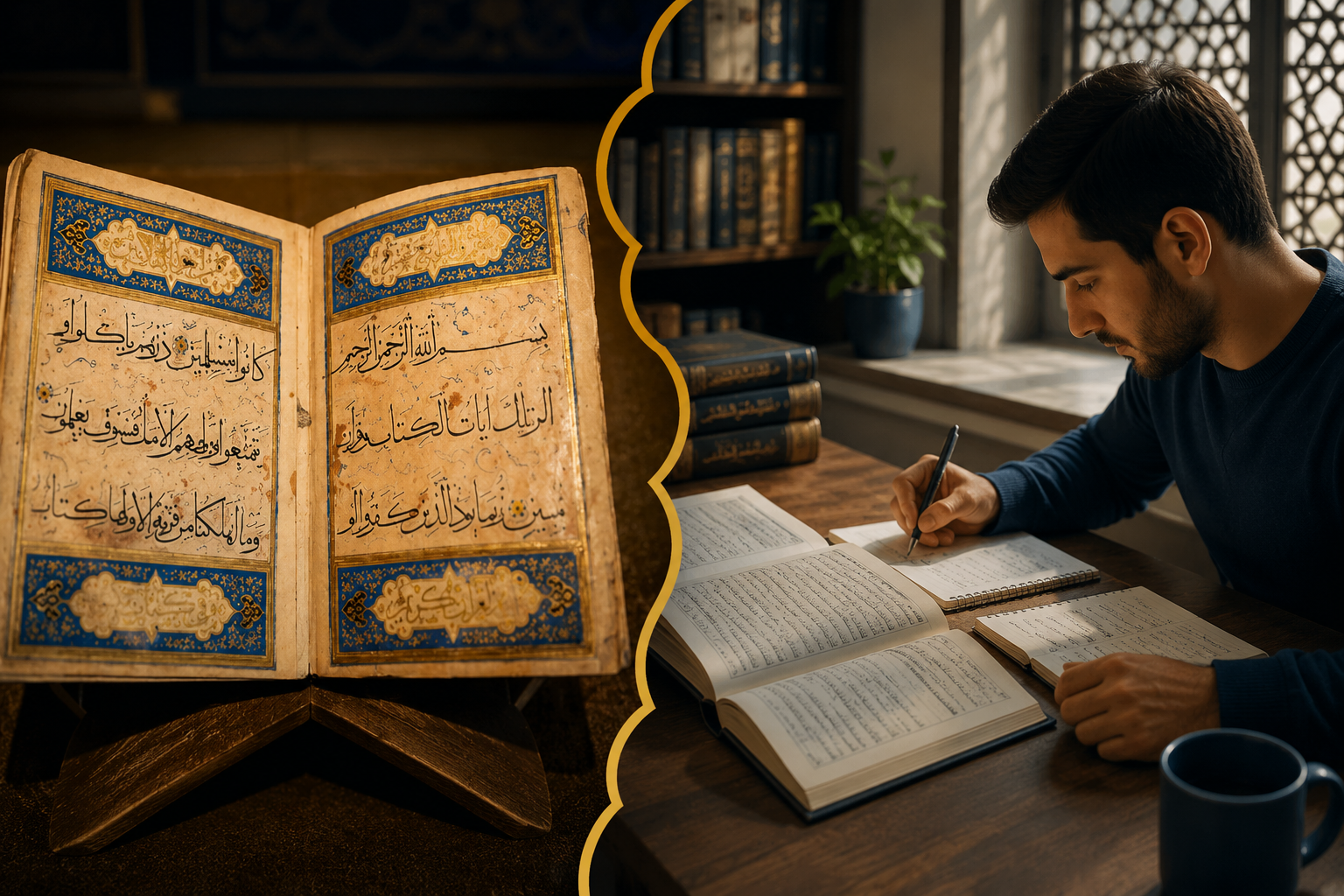
Arabic occupies a place in Islam that goes far beyond its role as a language of everyday communication. It is the language in which the Quran was revealed, the language in which the Prophet Muhammad ﷺ conveyed his teachings, and the language in which much of the foundational intellectual tradition of Islam was developed.
This does not mean that Islam belongs only to Arabic speakers. From its earliest centuries, Islam crossed linguistic and cultural boundaries, and Muslims have studied, taught, and explained their faith in countless languages.
Yet something important remains: the primary sources themselves are Arabic.
For anyone seeking an advanced and direct understanding of the Quran, Hadith, Tafsir, Islamic jurisprudence, or classical Islamic scholarship, Arabic therefore becomes more than a useful skill. It becomes a key to the sources themselves.
The Quran and Its Arabic Language
The Quran repeatedly draws attention to the language of its revelation.
In Surah Yusuf, it states:
“Indeed, We have sent it down as an Arabic Quran so that you may understand.”
Quran 12:2
Elsewhere, the Quran describes the revelation as being:
“in a clear Arabic language.”
Quran 26:195
These descriptions matter. The Quran is not simply a message whose original linguistic form is incidental to its meaning. Its vocabulary, syntax, rhythm, sound, word order, imagery, and rhetorical structure all contribute to the way its meanings are expressed.
This becomes particularly clear when we examine Arabic vocabulary.
Arabic is built extensively around roots and morphological patterns. Words derived from the same root often form networks of related meanings.
Consider the root:
R-Ḥ-M — ر ح م
From it come words such as:
raḥmah — رحمة — mercy
raḥīm — رحيم — merciful
al-Raḥmān — الرحمن — The Most Merciful
raḥim — رحم — womb
These words are not interchangeable, but their morphological relationship allows an Arabic reader to perceive connections that may be less visible once each word is translated separately into another language.
This is one reason translation, however excellent, cannot reproduce every dimension of the original text.
Translation Gives Access — But It Also Requires Choices
Translations of the Quran have played an enormously important role in making its meanings accessible to people around the world.
But every translation involves interpretation.
An Arabic word may have several possible shades of meaning. A grammatical construction may allow an emphasis that sounds unnatural when reproduced literally in English. A rhetorical feature may depend on sound, repetition, word order, or morphology. The translator must therefore make choices.
Something is inevitably gained through explanation, but something may also become less visible.
This is why comparing translations of the same Quranic verse can sometimes produce noticeably different English expressions even when the translators are working from exactly the same Arabic text.
The problem is not necessarily that one translator is right and another is wrong. Sometimes the Arabic expression contains a range of meaning that cannot be compressed neatly into a single English equivalent.
Learning Arabic does not make translation unnecessary. It allows the student to see what lies behind the translation.
The Quran as a Linguistic Text
For students of Arabic, the Quran also offers something remarkable: a text in which grammar, morphology, semantics, and rhetoric constantly interact.
A change in word order may create emphasis.
A morphological pattern may add intensity or continuity.
A definite or indefinite noun may affect interpretation.
A preposition may carry a nuance for which another language requires several words.
An omitted element may be understood naturally by an Arabic reader while requiring explicit explanation in translation.
These are not merely ornamental features.
For centuries, scholars of Tafsir, Arabic grammar, Balaghah, and Usul al-Fiqh examined precisely such linguistic details when interpreting Quranic passages.
This is where knowing Arabic changes the nature of Quranic study. The learner moves from asking only:
“What does this translation say?”
to asking:
“Why was it expressed this way in Arabic?”
That is a fundamentally different level of engagement with the text.
The Sunnah and the Power of Concise Arabic
The importance of Arabic extends equally to the Sunnah.
The sayings of Prophet Muhammad ﷺ are preserved primarily through Arabic reports, and the classical Islamic tradition describes the Prophet as having been given Jawāmiʿ al-Kalim — the ability to express extensive meanings in remarkably concise words.
This concision presents a challenge for translation.
A short prophetic statement may contain grammatical relationships, rhetorical emphasis, implied meanings, or semantic possibilities that require a much longer explanation in another language.
Understanding Hadith therefore involves more than replacing Arabic words with English equivalents.
The student must often consider what a word meant in its historical linguistic environment, how a grammatical construction functions, whether an expression is general or restricted, and how other texts affect its interpretation.
These questions become particularly important when Hadith is used in theology, ethics, or Islamic law.
Why Arabic Matters in Islamic Jurisprudence
Perhaps nowhere is the relationship between language and Islamic scholarship clearer than in Usul al-Fiqh, the principles by which jurists interpret religious texts and derive legal rulings.
Classical scholars examined linguistic questions such as:
ʿĀmm and Khāṣṣ — general and specific expressions
Muṭlaq and Muqayyad — absolute and restricted expressions
Amr — imperative forms
Nahy — forms of prohibition
Ḥaqīqah and Majāz — literal and figurative usage
But these categories cannot simply be reduced to mechanical grammatical formulas.
Whether an imperative indicates obligation, recommendation, permission, or another meaning may depend not only on the grammatical form itself but also on context, accompanying evidence, related texts, and established principles of interpretation.
Arabic is therefore not a shortcut to Islamic scholarship.
It is one of its essential tools.
Knowing Arabic does not automatically make someone a jurist, theologian, or Quranic commentator. But advanced scholarship in these fields becomes extremely difficult without it.
Reading the Classical Tradition Directly
The importance of Arabic becomes even clearer once we move beyond the Quran and Hadith.
An enormous intellectual civilization developed around these texts.
Tafsir.
Hadith commentary.
Fiqh.
Usul al-Fiqh.
Theology.
Biography.
History.
Arabic linguistics.
Rhetoric.
Spirituality.
Philosophy.
Works by scholars such as al-Tabari, al-Shafiʿi, al-Ghazali, Ibn Kathir, al-Nawawi, Ibn Hajar, and countless others remain central to Islamic intellectual history.
Translations provide valuable access to some of these works, but only a fraction of the classical Arabic corpus has been translated.
Learning Arabic therefore opens not merely one book, but an entire library.
Instead of encountering Islamic civilization primarily through selections chosen and interpreted by translators, the advanced student can begin to approach its intellectual tradition directly.
Arabic and Protection Against Misreading
There is another important benefit.
Translations can sometimes create an illusion of simplicity.
A translated sentence may appear completely straightforward even when the Arabic original has been debated by grammarians, jurists, or commentators for centuries.
Learning Arabic helps the student recognize these complexities.
They can begin to distinguish between the text itself and one particular translation of the text. They can compare interpretations, consult dictionaries and commentaries, examine grammatical arguments, and understand why scholars sometimes reached different conclusions from the same passage.
Arabic does not eliminate disagreement.
It allows us to understand the disagreement more accurately.
That distinction is essential.
Arabic and the Spiritual Experience of Islam
The relationship between Arabic and Islam is not exclusively academic.
It is also experienced daily in worship.
Muslims around the world perform Salah using Arabic. They recite Quranic verses in Arabic regardless of whether their native language is English, Indonesian, Turkish, Urdu, Swahili, French, or another language.
For someone who does not understand Arabic, these words may initially be learned through sound and memorization.
But understanding gradually changes the experience.
Allāhu Akbar is no longer simply a familiar phrase.
Al-ḥamdu lillāhi rabbil-ʿālamīn is no longer merely a sequence of memorized sounds.
The worshipper begins to recognize vocabulary, grammatical relationships, emphasis, imagery, and meaning while reciting.
The distance between recitation and comprehension begins to narrow.
For many learners, this is one of the most powerful reasons to study Arabic: the language moves from something they pronounce to something they understand.
Arabic Is a Bridge, Not a Barrier
None of this means that someone must master Arabic before beginning to learn about Islam.
That would turn the language into a barrier when it should be a bridge.
Translations, teachers, commentaries, lectures, and educational resources remain indispensable, especially for beginners.
The distinction is one of depth.
A person can learn a great deal about Islam through another language.
But as the student moves toward deeper and more independent engagement with the Quran, Hadith, Tafsir, Fiqh, and the classical scholarly tradition, dependence on translation increasingly becomes a limitation.
Arabic gradually changes from an advantage into a necessity.
From Translation to Direct Understanding
Learning Arabic for Islamic studies is not simply about accumulating vocabulary or memorizing grammatical rules.
It is about reducing the distance between the reader and the source.
At first, the learner reads a verse and then searches for its translation.
Later, individual words become recognizable.
Then structures become familiar.
Connections between words begin to appear.
Eventually, the learner starts noticing things that translation alone could not easily reveal: why one word was chosen rather than another, why the sentence was arranged in a particular way, why commentators discussed a grammatical possibility, or why jurists disagreed about the implications of an expression.
At that point, Arabic is no longer merely the language being studied.
It has become the language through which something else is being discovered.
Conclusion
Arabic holds a distinctive position in the Islamic tradition because it is inseparable from the form in which its foundational texts were transmitted.
The Quran is an Arabic Quran. The Hadith tradition preserves the Arabic speech attributed to the Prophet Muhammad ﷺ. And centuries of scholarship developed through close attention to the vocabulary, grammar, rhetoric, and semantic possibilities of these texts.
Translation can carry meaning across languages, and it remains invaluable.
But translation is also an interpretation.
For the reader who wants to move beyond receiving an interpretation and begin examining the sources more directly, Arabic opens another door.
It provides access not only to words, but to relationships between words; not only to conclusions, but to the reasoning behind them; not only to translated selections, but to a vast scholarly tradition in its original language.
For the serious student of the Quran, the Sunnah, and Islamic civilization, learning Arabic is therefore more than learning another language.
It is learning to approach the sources on their own terms.