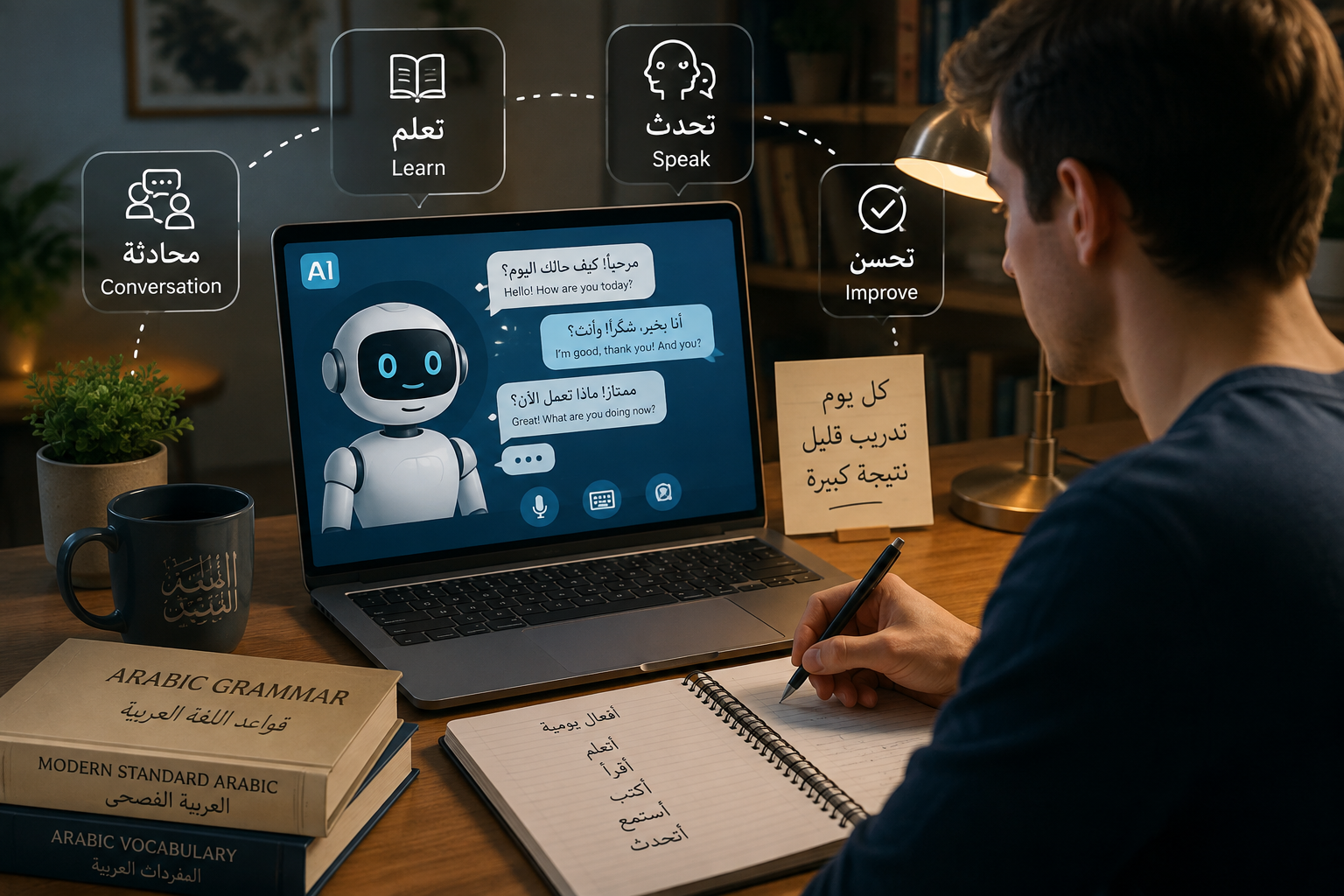
You can study Arabic for years and still struggle to speak it.
You may know the grammar. You may have memorized hundreds—or even thousands—of words. You may understand textbook dialogues, complete exercises successfully, and recognize structures when you see them.
Then someone speaks to you in Arabic.
Suddenly, the words disappear.
This is not necessarily a failure of memory or intelligence. Often, the problem is much simpler: you have learned Arabic, but you have not lived enough of your life through Arabic.
Languages are not mastered only by studying them. They are mastered by using them: asking questions, searching for words, misunderstanding people, correcting yourself, telling stories, reacting spontaneously, and trying again.
For learners living outside an Arabic-speaking community, this has always been one of the greatest obstacles.
Artificial intelligence is beginning to change that.
Not because AI can replace a good teacher, and certainly not because speaking to a machine is identical to speaking to a human being. It is not.
But AI can provide something that many Arabic learners have never had before:
a language environment that is available whenever they need it.
The Real Problem Is Often Not Knowledge
Imagine two students who have studied Arabic for the same number of hours.
The first studies Arabic three times a week but rarely uses it outside class.
The second studies the same lessons but also speaks Arabic every day. He orders food in Arabic, asks for directions, explains problems, hears different responses, makes mistakes, reformulates sentences, and gradually learns to respond without translating everything in his head.
After a year, their abilities may be dramatically different.
Why?
Because knowing a language and retrieving it in real time are different skills.
A learner may recognize:
أريد أن أحجز موعدًا.
“I want to book an appointment.”
But recognition is not the same as being able to produce the sentence immediately when needed.
Real conversation demands retrieval under pressure. You must choose vocabulary, construct a sentence, understand the response, and prepare your next thought—often within seconds.
That ability develops through repeated use.
Traditionally, learners outside the Arab world had limited ways to create this kind of practice. They could find a language partner, pay for additional lessons, join conversation groups, watch Arabic media, or travel.
All of these remain valuable.
But AI introduces another possibility: you can deliberately manufacture moments in which Arabic becomes necessary.
Stop Treating AI as a Dictionary
One of the least interesting ways to use AI for language learning is simply to ask:
“What does this Arabic word mean?”
There is nothing wrong with that. But it barely touches the potential of the technology.
Instead of treating AI as an advanced dictionary, treat it as a conversation partner, role-play partner, pronunciation coach, writing assistant, error detector, and simulation engine.
Do not merely ask AI about Arabic.
Do things in Arabic with AI.
That distinction matters.
You can ask it to become a hotel receptionist in Dubai while you try to book a room. Tomorrow, it can become a taxi driver. The next day, a colleague at work. Then a shopkeeper, a doctor’s receptionist, a university student, an immigration officer, or a friend discussing weekend plans.
The goal is not to collect dialogues.
The goal is to make you produce the language.
Build Situations, Not Just Conversations
Random conversation has value, but structured simulation is much more powerful.
Suppose you are learning Arabic at A2 level and want to practise going to a restaurant.
Instead of saying:
“Practise Arabic with me.”
give AI a role and rules:
“You are a waiter in an Arabic-speaking restaurant. Speak to me only in simple Arabic appropriate for A2 level. Do not translate unless I ask. Ask me one question at a time and wait for my answer. If I make a serious mistake, briefly correct it and continue the conversation. Do not write my answers for me.”
Now you are not studying a restaurant dialogue.
You are inside one.
The waiter may ask:
ماذا تحب أن تطلب؟
You answer.
Then something unexpected happens:
عذرًا، هذا الطبق غير متوفر اليوم.
Now you have to react.
That unexpected turn is important. Real conversations are unpredictable. Good AI practice should be unpredictable too.
Ask the AI to occasionally introduce realistic complications: the hotel room you requested is unavailable; the taxi driver did not understand the address; the shop does not have your size; your appointment has been moved; your colleague disagrees with you.
Language develops when communication requires adjustment.
Make AI Respect Your Level
One danger of practising with AI is that it can easily produce Arabic that is far beyond the learner’s ability.
A beginner asks a simple question and receives a beautifully written paragraph containing vocabulary he will not need for another three years.
That is not useful immersion. It is linguistic overload.
Tell the AI your approximate level and control its language.
For example:
“Speak to me at B1 level. Use mostly high-frequency vocabulary. Keep your responses to two or three sentences. Introduce no more than two new expressions in each exchange.”
For beginners, you can ask for shorter sentences and slower progression. For advanced learners, do the opposite:
“Speak naturally. Do not simplify your Arabic unless I ask you to. Challenge me to express more precise ideas and point out expressions that sound translated from English.”
AI becomes much more useful when the difficulty is slightly above your current comfort zone, rather than dramatically above it.
Do Not Let AI Help Too Quickly
This may be the most important rule.
If you cannot remember a word, resist the temptation to ask for it immediately.
Try to explain it using Arabic you already know.
If you forget the word مظلة (umbrella), for example, try:
الشيء الذي نستخدمه عندما ينزل المطر.
That struggle is not wasted time.
It is language learning.
In real life, you will often forget words. Fluent speakers are not people who never forget vocabulary; they are people who know how to keep communicating when they do.
AI can help you practise this deliberately.
Tell it:
“If I do not know a word, do not give me the English translation immediately. First help me discover the Arabic word through simple Arabic clues.”
Now AI becomes less of an answer machine and more of a training partner.
Use Voice, Not Only Text
If your goal is speaking, typing Arabic for an hour is not equivalent to speaking Arabic for an hour.
Text practice gives you time to think, edit, delete, and reconstruct. Conversation does not.
Voice interaction changes the exercise.
Speak without preparing sentences in advance. Describe what happened during your day. Explain your opinion. Retell a story. Ask questions. Respond to follow-up questions.
Most importantly, practise turn-taking.
Ask AI to interrupt naturally with questions, request clarification, or challenge something you said.
You can even impose time pressure:
“Ask me ten everyday questions in Arabic. Give me only a few seconds to begin answering each one. I want to practise responding without translating in my head.”
The objective is not perfect Arabic.
The objective is to reduce the distance between thought and Arabic expression.
Turn Your Mistakes Into a Personal Curriculum
A human teacher may notice that you repeatedly confuse masculine and feminine agreement. Perhaps you misuse prepositions. Perhaps your sentences are grammatically correct but sound unnatural. Perhaps you understand past tense forms easily but hesitate with attached pronouns.
AI can help identify these patterns—if you ask it to.
After a conversation, request an analysis:
“Review our conversation. Identify my five most important recurring mistakes. Ignore minor mistakes. For each one, show what I said, give a natural correction, explain the problem briefly, and give me one new sentence to practise.”
Then go one step further.
Ask AI to create tomorrow’s conversation around those weaknesses.
This creates a powerful cycle:
Speak → make mistakes → identify patterns → practise them → speak again.
Your errors stop being embarrassing interruptions and become data for the next lesson.
Create an Arabic-Only Zone
One of the most effective ways to use AI is to establish a daily period during which English—or your native language—is simply unavailable.
Start with fifteen minutes.
During those fifteen minutes, communicate only in Arabic.
If you do not understand something, ask:
ماذا تعني هذه الكلمة؟
If the explanation is difficult:
هل تستطيع أن تشرح بطريقة أسهل؟
If you need repetition:
هل تستطيع أن تقول ذلك مرة أخرى؟
If you need an example:
أعطني مثالًا، من فضلك.
These expressions are not obstacles to conversation. They are conversation.
Gradually extend the Arabic-only period from fifteen minutes to thirty, then forty-five, then an hour.
The aim is to train yourself to solve communication problems inside Arabic rather than escaping from Arabic every time a problem appears.
Standard Arabic or Dialect? AI Can Help With Both
Arabic presents a challenge that learners of many other languages do not encounter in quite the same way: the relationship between Modern Standard Arabic and regional dialects.
AI can help learners navigate this distinction more deliberately.
You might practise a situation first in Modern Standard Arabic, then ask:
“Now repeat the same situation in Emirati Arabic. Point out the most important differences in vocabulary and pronunciation.”
Or Egyptian, Levantine, Saudi, Moroccan, or another variety depending on your goals.
However, dialect practice requires caution. AI can sometimes mix dialects, overgeneralize regional expressions, or produce forms that native speakers would not naturally use.
For dialects especially, AI should supplement—not replace—exposure to real native speech.
Listen to native speakers. Watch interviews, programmes, podcasts, and everyday conversations. Then bring what you hear back to AI and practise using it.
Make Your Real Life the Curriculum
The most powerful practice material is often your own life.
If you have a job interview next week, simulate it.
If you are travelling to an Arab country, practise the conversations you are likely to have.
If you work with Arabic-speaking clients, rehearse your professional interactions.
If you want to make friends in Arabic, practise introducing yourself, telling stories, asking follow-up questions, expressing surprise, agreeing politely, and disagreeing without sounding aggressive.
You can even tell AI:
“Tomorrow I will visit a government office in Abu Dhabi. Simulate five conversations I may realistically have there. Do not show me model answers. Speak to me as the employee and make me respond.”
This is where AI becomes particularly useful.
The curriculum no longer has to be generic.
Your life can become your syllabus.
A Simple 30-Minute Daily AI Routine
You do not need hours of practice.
A focused thirty-minute session can be extremely productive.
Spend the first five minutes warming up: describe your day without preparation.
Spend the next fifteen minutes in a realistic role-play based on a situation relevant to your life.
Then spend five minutes reviewing your most important mistakes.
Use the final five minutes to repeat corrected sentences aloud and reuse the new expressions in different contexts.
Tomorrow, begin with yesterday’s weaknesses.
Over time, this creates continuity. You are no longer having isolated conversations with AI. You are building a personalised training system.
What AI Cannot Give You
There is an important limit to all of this.
AI is not an Arab community.
It cannot fully reproduce the emotional, cultural, social, and unpredictable experience of interacting with human beings. Real speakers hesitate, interrupt, joke, misunderstand, use body language, change topics unexpectedly, speak over noise, shorten words, use local references, and sometimes say things that no textbook—or chatbot—would predict.
Human interaction therefore remains essential.
A skilled teacher also does far more than correct sentences. A teacher understands the learner, chooses what deserves attention, detects problems the learner does not notice, and provides pedagogical direction over time.
The strongest approach is not:
AI instead of teachers and native speakers.
It is:
teachers + authentic Arabic + human interaction + AI-supported daily practice.
Each solves a different problem.
The End of the “No One to Practise With” Problem?
For decades, a student living far from the Arab world could reasonably say:
“I understand Arabic, but I have nobody to speak Arabic with.”
That excuse is becoming less convincing.
Today, the learner can create a restaurant in Cairo before breakfast, a business meeting in Riyadh during lunch, a taxi ride in Abu Dhabi in the afternoon, and a conversation with a friend in Damascus before going to bed.
None of these simulations is identical to reality.
But each can prepare the learner for reality.
The greatest educational potential of artificial intelligence may therefore lie not in giving students more information. Language learners already have more information than they can possibly consume.
Its greater value may be in giving them something much harder to find:
a place to use what they know.
A language cannot live only in notebooks, vocabulary lists, and grammar exercises.
It has to be spoken.
It has to be tested.
It has to fail occasionally.
And it has to be used again.
If the Arabic-speaking environment you need does not exist around you, artificial intelligence can now help you build part of that environment yourself.
And perhaps that is the real shift:
AI does not have to become your Arabic teacher.
It can help make Arabic part of your daily life.