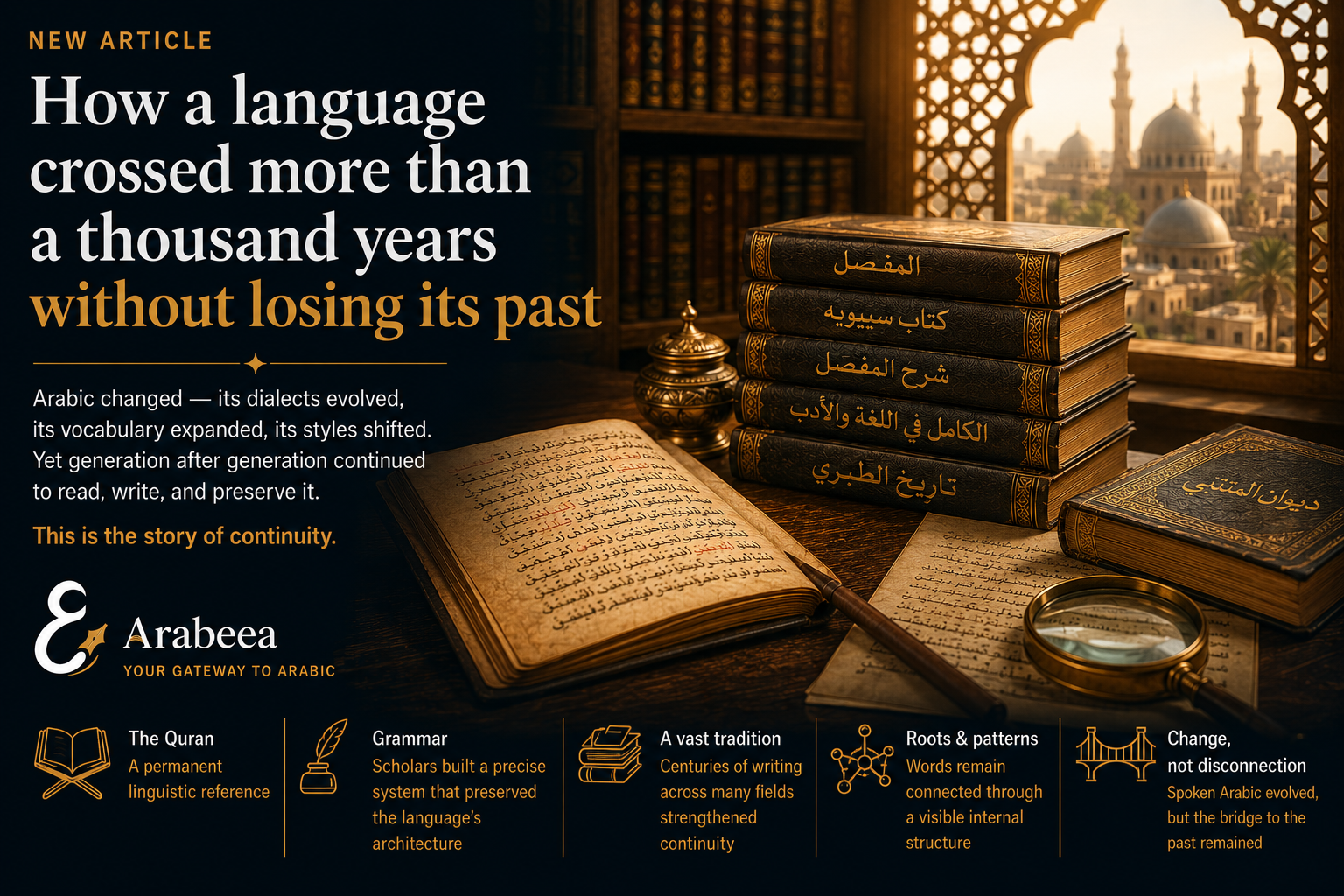
How a language crossed more than a thousand years without losing its past
Languages change. It is one of the most ordinary facts of human history.
Words disappear. Pronunciations shift. Grammar simplifies or reorganizes itself. Meanings drift. After enough centuries, the language of the ancestors may become almost a foreign language to their descendants.
An English speaker today cannot simply open Beowulf, written roughly a thousand years ago, and read it as ordinary English. Old English requires study. Even the English of Chaucer, several centuries later, presents serious difficulties to the modern reader. Similar distances separate modern speakers of many languages from important stages of their linguistic past.
Arabic presents a remarkable contrast.
An educated Arabic speaker today can open a book written eight hundred, a thousand, or even twelve hundred years ago and often recognize its grammar, follow much of its vocabulary, and understand the structure of its sentences. There will certainly be unfamiliar words, difficult expressions, specialized terminology, and stylistic obstacles. Yet the language itself does not appear entirely foreign.
A text written in Baghdad in the ninth century, Damascus in the twelfth, Cairo in the fourteenth, or Fez in the fifteenth still belongs, in an important sense, to the linguistic world of the modern Arabic reader.
How did this happen?
The answer is not that Arabic somehow escaped linguistic change. It did not. Spoken Arabic changed considerably, producing the rich variety of dialects heard across the Arab world today.
The real story is more interesting.
Arabic changed — but it also developed unusually powerful mechanisms for preserving continuity.
The Quran Created a Permanent Linguistic Reference Point
No explanation of Arabic’s historical continuity can begin anywhere other than the Quran.
When the Quran became the central text of Islamic civilization, the Arabic in which it was revealed acquired a status far beyond that of an ordinary historical stage of a language. It became a permanent object of reading, recitation, memorization, interpretation, and grammatical analysis.
Generation after generation encountered the same text.
A Muslim living in the tenth century recited the Quran. So did one living in the fifteenth century. So does one living in the twenty-first.
This created something rare in linguistic history: an ancient linguistic model that never truly became ancient.
The Quran was not preserved only in libraries. It remained in daily religious life. Its language continued to be heard in prayer, studied in schools, quoted in sermons, discussed by scholars, and memorized by children and adults.
Consequently, the linguistic past was never completely disconnected from the present.
Arabic Grammar Preserved the Architecture of the Language
The Quran alone, however, does not explain everything.
Early Muslim scholars developed one of history’s most sophisticated traditions of grammatical analysis. Grammarians such as Sibawayh did not merely record vocabulary; they described the internal system of Arabic with extraordinary precision.
Case endings, verb patterns, sentence structures, derivational rules, agreement, particles, sound changes, and morphological patterns were analyzed and transmitted systematically.
This mattered enormously.
Once a language possesses a respected grammatical standard that is continuously taught across generations, linguistic change does not disappear — but the written standard becomes far more resistant to fragmentation.
Arabic therefore acquired not only great literature, but also a powerful intellectual infrastructure for preserving access to that literature.
Grammar became a bridge across centuries.
A Vast Written Tradition Reinforced the Standard
There was another important factor: Arabic never depended on a single book.
For centuries it served as a major language of religion, law, philosophy, medicine, astronomy, mathematics, history, poetry, administration, and literature across an enormous geographical area.
A scholar in medieval Baghdad might write in Arabic. So might a physician in Damascus, a jurist in Cairo, a philosopher in Andalusia, or a historian in North Africa.
This enormous written civilization continuously reinforced a shared literary language.
New generations did not merely inherit old texts. They actively read them, commented on them, summarized them, challenged them, taught them, and wrote new books in conversation with them.
The result was continuity through use.
Classical Arabic did not survive because it was placed behind glass. It survived because generation after generation continued to need it.
The Root-and-Pattern System Helped Preserve Recognition
Arabic morphology also contributes to this remarkable continuity.
Arabic words are frequently organized around recognizable roots and patterns. A reader encountering an unfamiliar word may still recognize its root and connect it to a wider family of meanings.
The root ك-ت-ب, for example, connects words associated with writing:
كتب — he wrote
كتاب — book
كاتب — writer
مكتوب — written
مكتبة — library
This does not prevent vocabulary from changing, nor does it make every old word immediately understandable. But it gives Arabic an unusually visible internal architecture.
Words are not always isolated units that must be memorized independently. They often belong to families.
That structure helps readers recognize relationships even when particular forms are unfamiliar.
But Arabic Did Change
This point is essential.
Saying that Arabic preserved extraordinary continuity does not mean that an Arab today speaks exactly like an Arab living a thousand years ago.
Far from it.
Spoken Arabic evolved dramatically. Egyptian Arabic, Levantine Arabic, Gulf Arabic, Iraqi Arabic, Maghrebi varieties, and many others developed distinctive pronunciation, vocabulary, expressions, and grammatical tendencies.
Arabic therefore experienced linguistic change like every living language.
What makes its history unusual is that the development of everyday speech did not destroy access to the older literary language.
Two processes occurred simultaneously:
change in spoken language and continuity in the formal language.
Modern Standard Arabic is not identical to the Arabic of the earliest centuries, and Classical Arabic itself contained variation. Yet the degree of structural and lexical continuity is sufficient for educated modern readers to enter a remarkably old textual tradition without first learning an entirely separate language.
That distinction matters.
The achievement of Arabic is not immobility.
It is continuity.
Compare This with English
The contrast with English makes the phenomenon easier to see.
Consider the opening of Beowulf:
Hwæt! We Gardena in geardagum…
This is English — historically.
But to most modern English speakers, it looks like another language.
A thousand years of sound change, grammatical transformation, vocabulary replacement, and historical disruption created a profound distance between Old English and Modern English.
An English speaker must study Old English in much the same way that one studies another language.
Now consider an educated Arabic reader opening a prose work from the Abbasid period.
The reader may encounter obscure vocabulary and complex style. Some passages may require explanation. But basic elements remain recognizable: pronouns, verb structures, particles, roots, morphological patterns, and much of the syntax.
The distance exists.
But the bridge remains.
The Secret Is Not One Factor, but an Ecosystem
Arabic’s continuity cannot be explained by a single cause.
The Quran provided an enduring linguistic reference.
Religious practice kept that reference alive in the lives of millions.
Grammarians codified the structure of the language.
Schools transmitted that structure.
A vast civilization produced and preserved an enormous body of Arabic writing.
Morphology gave vocabulary a strongly interconnected architecture.
And later generations continued to read earlier generations rather than abandoning their linguistic inheritance.
Together, these forces created an extraordinary historical chain.
Arabic did not simply preserve old books.
It preserved the ability to read them.
A Language with a Long Memory
Perhaps this is the most remarkable feature of Arabic.
Many civilizations preserve their ancient texts, but often through specialists, translations, or the study of an older form of the language.
Arabic offers something different.
A modern reader can still approach voices separated from him or her by many centuries through a linguistic system that remains recognizably connected to the one they used.
Not effortlessly. Not perfectly. And certainly not without education.
But directly enough for the past to remain linguistically present.
That is why Arabic should not be described simply as a language that “did not change.” Such a statement would underestimate the complexity of its history.
Arabic did something more remarkable:
it changed without completely severing the road back to its origins.
Its dialects evolved. Its vocabulary expanded. Its styles changed. Modernity introduced thousands of new expressions and concepts.
Yet beneath those changes, a powerful line of continuity survived.
For more than a millennium, Arabic has allowed generation after generation to speak to the past without requiring translation between them.
And perhaps that is the better way to understand its uniqueness:
Arabic is not a language that refused to change.
It is a language that changed without forgetting who it was.