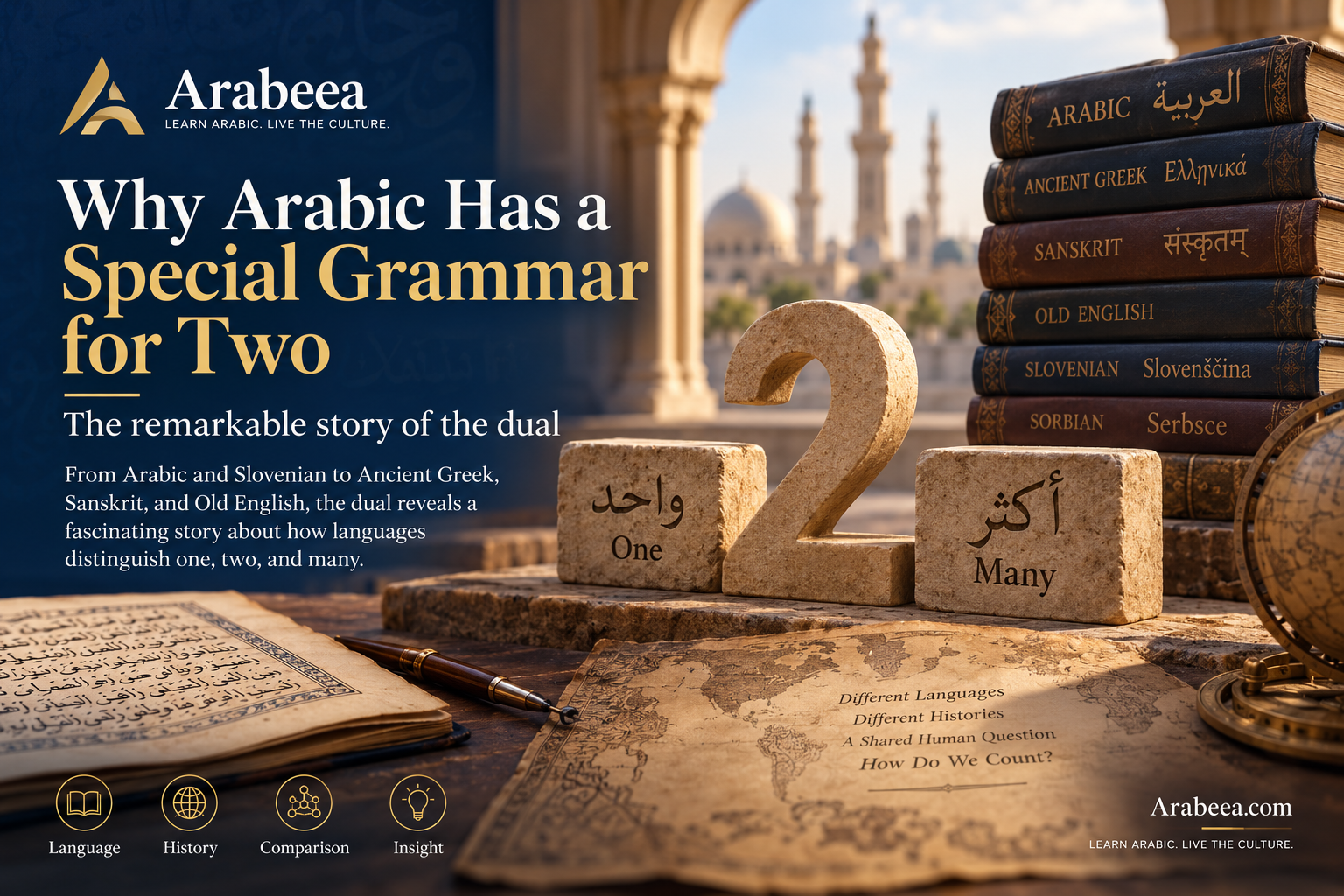
Why Arabic Has a Special Grammar for Two: The Remarkable Story of the Dual
From Arabic and Slovenian to Ancient Greek, Sanskrit, and Old English, the dual reveals a fascinating story about how languages distinguish one, two, and many.
Most languages make a distinction that seems perfectly sufficient: one thing, or more than one.
English has a book and books, a student and students. French, Spanish, German, and many other major languages follow essentially the same numerical division. Grammatically, two books belong to the same broad category as twenty books: both are plural.
Arabic sees the matter differently.
Between the singular and the plural, Arabic preserves a third grammatical category: the dual (المثنى), a form specifically designed for exactly two.
One book is:
كتاب — kitāb
Two books are:
كتابان — kitābān
Three or more books are:
كتب — kutub
This may appear at first to be merely another grammatical rule for Arabic learners to memorize. In fact, it opens a window onto something much larger: the different ways human languages encode number.
The dual is not an Arabic invention, nor is Arabic the only language that possesses it. What makes Arabic particularly interesting is that it has preserved a productive dual system while many languages that once possessed one gradually abandoned it.
Two Is Not Simply “More Than One”
English grammar divides number primarily into two categories:
singular → plural
Arabic has a three-way distinction:
singular → dual → plural
This means that Arabic grammar recognizes “two” as a category worthy of its own morphological expression.
Consider:
طالب — one student
طالبان — two students
طلاب — students
The difference is deeper than simply adding the numeral “two.” The word itself changes to encode the quantity.
In the nominative case, masculine and many feminine nouns form the dual with ـان (-ān):
معلم → معلمان
teacher → two teachers
سيارة → سيارتان
car → two cars
In the accusative and genitive cases, the ending becomes ـين (-ayn):
رأيت معلمين
“I saw two teachers.”
The number is therefore built into the grammatical architecture of the noun.
Arabic can consequently express something like “the two teachers arrived” without needing to insert the numeral “two”:
وصل المعلمان.
The dual ending already tells the listener that exactly two teachers are involved.
Arabic Is Not Alone
The dual occurs in languages belonging to several unrelated language families. It is therefore not a uniquely Semitic phenomenon.
One of the most famous modern examples is Slovenian. Its dual is remarkably robust: special dual forms can appear not merely on nouns but also in other elements of the sentence, including adjectives and verbs.
For example, Slovenian distinguishes grammatically between one button, two buttons, and several buttons. Dual agreement may spread across the sentence rather than remaining confined to the noun. Linguistic research therefore frequently compares Slovenian with Arabic when investigating how speakers acquire grammatical number.
The Upper and Lower Sorbian languages, Slavic languages spoken in Germany, have also preserved the dual, although research indicates variation and some pressure toward its loss.
Forms of the dual also survive in other parts of the world. Several Austronesian and Polynesian languages, for example, distinguish dual number in their pronoun systems. A language may therefore distinguish between something equivalent to “we two” and “we, more than two,” even when its nouns do not possess a full Arabic-style dual system.
This distinction is important: saying that a language “has a dual” does not necessarily mean that it behaves like Arabic. In some languages the dual is productive in nouns; in others it is largely pronominal; in still others it survives only in restricted constructions.
Arabic belongs to the relatively striking group in which dual morphology remains an important and recognizable part of the grammatical system.
The Dual Was Once Much More Widespread
Perhaps the most fascinating part of the story is not where the dual exists today, but where it used to exist.
The reconstructed ancestor of the Indo-European language family, Proto-Indo-European, possessed a grammatical dual. This ancestral language eventually gave rise to enormous branches of languages including Greek, Indo-Iranian, Germanic, Slavic, Celtic, Italic, and others.
The dual survived in several important ancient Indo-European languages.
Ancient Greek possessed dual forms.
Sanskrit had a highly developed dual system.
Gothic preserved dual distinctions, particularly in parts of its pronominal and verbal system.
Old English retained dual pronouns.
Thus, the ancestors of modern English speakers could grammatically distinguish “we” from “we two” in ways modern English no longer does.
The same historical pattern occurred across much of the Slavic world. Early Slavic languages possessed a productive dual, but most later Slavic languages eventually replaced it with the ordinary plural. Slovenian and Sorbian are remarkable precisely because they resisted this broader historical trend.
So the linguistic map has changed dramatically.
Where many ancient languages once distinguished:
one → two → many
many of their descendants now distinguish only:
one → many
Arabic, by contrast, has retained the middle category.
What Happened to the Dual in English?
Old English provides an especially interesting comparison.
Modern English speakers say:
we
whether they mean two people or two thousand.
But Old English had special first- and second-person dual pronouns. The language could distinguish a group from a pair at the grammatical level.
Over time, these forms disappeared, and the ordinary plural absorbed their function. English therefore illustrates a common historical development: a grammatical distinction can disappear even though speakers obviously remain perfectly capable of understanding the underlying concept.
Modern English does not need a special dual grammatical number because it can simply say:
two students
both students
the two of us
The meaning survives. The grammatical category does not.
This is an important distinction.
Languages do not lose the concept of two when they lose the dual. They simply stop requiring their grammar to encode it systematically.
Why Do Languages Lose the Dual?
There is no single universal reason.
Languages constantly reorganize their grammatical systems. Frequently used distinctions may survive, while other distinctions become optional, merge with neighboring categories, or disappear altogether.
The dual is especially vulnerable because its function can easily be replaced.
A language does not strictly need a special word form meaning “two books” if it already possesses a numeral meaning “two.” Instead of maintaining three morphological categories—
book / two-books / books
—it can simplify the system to:
book / books
and use two books whenever precision is necessary.
Once plural forms increasingly replace dual forms in ordinary speech, the special dual paradigm may gradually shrink. It may first survive in pronouns or fixed expressions, then become increasingly marginal, and eventually disappear.
This process has happened repeatedly in linguistic history.
Why, Then, Is the Arabic Dual Valuable?
The value of the Arabic dual is not that Arabic speakers can express an idea that English speakers cannot.
English can obviously express “two students.”
The difference lies in how efficiently and systematically the information is encoded.
Arabic can package lexical and numerical information into a single form:
طالبان
means not merely “students,” but specifically two students.
The listener receives the quantity as part of the grammatical form itself.
This makes the dual a good example of what morphology can do: a small change in the structure of a word can carry information that another language may express through additional independent words.
A Grammar That Forces Attention to Number
The dual also creates a particularly interesting relationship between grammar and numerical awareness.
Research comparing children learning Slovenian and Saudi Arabic found an association between exposure to dual morphology and earlier acquisition of the meaning of the number word “two.” The researchers argued that grammatical marking may provide children with an additional source of information about exact quantity.
This does not mean that speakers of languages with a dual are inherently better at mathematics.
It means something subtler.
Their language repeatedly presents sets of two as a distinct grammatical category.
Every time a child encounters dual morphology, grammar is effectively signaling:
There are exactly two here.
That is a remarkable interaction between language and numerical cognition.
The Dual Also Reveals Something About Arabic Morphology
For learners, the dual is often introduced as another table of endings to memorize.
That approach misses its larger significance.
The dual demonstrates one of the central characteristics of Arabic: meaning is frequently compressed into morphology.
English often distributes information across several separate words:
the two teachers
Arabic can encode much of that information inside:
المعلمان
The definite article identifies definiteness, the lexical stem identifies the concept “teacher,” and the ending identifies the quantity as exactly two.
Arabic morphology therefore does not merely change the appearance of words. It packages grammatical information into them.
The dual is one of the clearest demonstrations of this principle.
But Spoken Arabic Complicates the Picture
There is an important qualification.
The dual remains fundamental to Modern Standard Arabic, but spoken Arabic dialects do not necessarily preserve the entire Classical or Standard Arabic agreement system in the same way.
Many contemporary dialects productively use dual noun forms, while agreement elsewhere in the sentence may behave differently. Research on Saudi Arabic, for example, distinguishes its nominal dual marking from the more extensive agreement patterns associated with Standard Arabic.
So it would be misleading to claim that every Arabic speaker uses the full Standard Arabic dual paradigm in everyday conversation.
What is remarkable is that the dual itself remains highly recognizable and productive across Arabic, particularly in nominal morphology, while Standard Arabic preserves it as a systematic grammatical category.
A Survivor From an Older Linguistic World
The Arabic dual becomes even more interesting when viewed historically.
A modern English speaker looking at the dual may initially regard it as an unusual complication:
Why should a language need three grammatical numbers when two will do?
Historical linguistics reverses the question.
Perhaps the more interesting question is:
Why did so many languages stop distinguishing two?
Ancient Greek knew the dual. Sanskrit knew it. Early Germanic languages preserved parts of it. Old English retained traces of it. Early Slavic had it. Yet in many descendant languages, the distinction was gradually absorbed into the plural.
Arabic therefore does not simply possess an exotic grammatical curiosity.
It preserves a type of numerical distinction that was once much more widespread.
More Than a Suffix
For the Arabic learner, ـان and ـين may initially look like two more endings in an already demanding grammatical system.
But behind those endings lies a much larger story.
The dual shows that human languages do not divide reality in identical ways. Some grammars treat everything beyond one as plural. Others distinguish two from larger groups. Some preserve that distinction only in pronouns. Others once possessed it and lost it.
Arabic chose—or, more accurately, historically preserved—a particularly explicit solution:
one is one, two is two, and many is many.
That distinction gives Arabic an economical way to encode exact quantity, creates a rich system of grammatical agreement, and offers linguists a living example of a category that has disappeared from many other major languages.
The المثنى is therefore more than an ending attached to a noun.
It is a surviving piece of linguistic history—and a reminder that grammar does not merely describe reality.
It decides which distinctions are important enough to build directly into words.