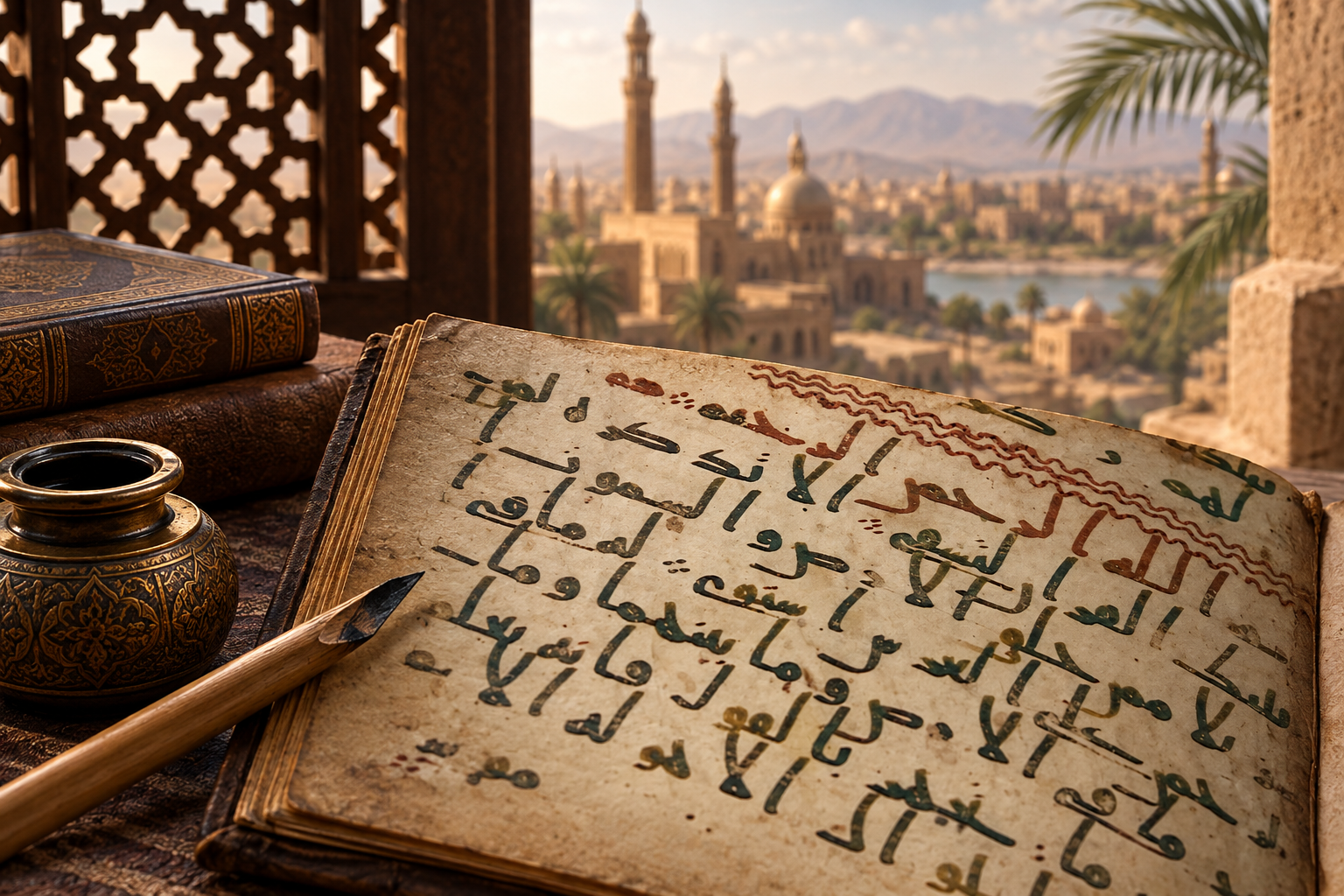
Why Is Arabic Written from Right to Left? The Real Story Behind Arabic Writing
If you are learning Arabic for the first time, one of the first things you notice is not a new sound or an unfamiliar letter.
It is the direction.
Your eyes move to the right side of the page, and the sentence begins there. Arabic is written and read from right to left — the opposite of English and most European languages.
But why?
Was Arabic designed this way because of the way ancient Arabs held their writing tools? Did it have something to do with stone carving? Is there something about the Arabic language itself that naturally requires writing from right to left?
The answer is more interesting — and more historical — than any of these explanations.
Writing Direction Belongs to the Script, Not the Language
The first distinction is essential: Arabic is a language, while the Arabic alphabet is a writing system.
Languages do not naturally move from right to left or from left to right. Writing direction is primarily a feature of the script used to represent a language.
This becomes clear when we look beyond Arabic itself.
Persian, Urdu, and Pashto are different languages, yet they are also written from right to left because they use writing systems derived from the Arabic script.
The reverse can happen as well. A language can change scripts and consequently change writing direction. Turkish provides a well-known example: Ottoman Turkish was written using a modified Arabic script from right to left, while modern Turkish uses the Latin alphabet and is written from left to right.
So the real question is not simply:
Why does the Arabic language go from right to left?
It is:
Why did the Arabic script inherit this direction?
Arabic Is Part of a Much Older Writing Tradition
The Arabic script did not appear suddenly.
Its history stretches back through earlier writing traditions of the Near East. The development of Arabic writing is closely connected with the Nabataean script, itself related to the broader Aramaic and North Semitic writing traditions.
The Nabataeans lived across areas that include parts of modern Jordan, southern Syria, northern Arabia, and the Sinai Peninsula. Their writing system was generally written from right to left.
Over time, Nabataean writing became increasingly cursive. Letters changed shape, connections between letters developed, and the script gradually moved toward forms recognizable as early Arabic.
This was not a single moment of invention.
It was a long process of development.
Inscriptions from the centuries before Islam show transitional forms between Nabataean and recognizable Arabic writing. Rather than imagining someone sitting down one day and designing the Arabic alphabet, it is more accurate to think of generations of writers gradually transforming an existing writing tradition.
And throughout that transformation, one fundamental convention remained:
the direction of writing.
Arabic therefore inherited right-to-left writing from traditions that were already using it long before the mature Arabic script emerged.
But Why Did Ancient Scripts Write from Right to Left?
This is where the answer becomes less certain.
Several popular explanations are frequently repeated.
One claims that ancient stone carvers held a hammer in their right hand and a chisel in their left, making it easier to carve from right to left.
Another connects writing direction with right-handedness.
A third explanation suggests that the direction developed because of the writing tools or surfaces used by ancient scribes.
These ideas are not impossible. Writing materials certainly influence the development of scripts. Carving letters into stone is different from writing with ink on papyrus, parchment, or paper.
But there is a problem.
We do not have sufficient evidence to identify one of these explanations as the single proven reason that right-to-left writing originally developed.
The history of writing is more complicated than that.
Different ancient scripts used different directions. Some early writing traditions even alternated direction from one line to the next, a system known as boustrophedon.
So while writing tools, hand movements, and materials may have influenced the development of writing direction, the safest historical conclusion is much simpler:
Arabic is written from right to left because it inherited that convention from earlier writing traditions.
Exactly why those much older traditions originally preferred that direction is harder to establish with certainty.
From Nabataean to Arabic
The transition from Nabataean writing to Arabic was gradual.
Historical inscriptions show that letterforms changed over centuries rather than appearing suddenly in their later Arabic forms.
This helps explain why writing direction remained stable.
When a writing system evolves, not every feature changes at the same time. Letter shapes can change. Letters can become more connected. New distinctions can develop between similar characters. Diacritical marks can appear.
Yet the direction of the line can remain unchanged.
By the time Arabic writing developed into its more recognizable forms, right-to-left movement was already an established scribal convention.
It was not a new decision made specifically for Arabic.
It was inherited.
Why Did Arabic Keep This Direction?
Inheritance explains how Arabic acquired right-to-left writing.
But another question remains:
Why did it survive for so many centuries?
Because writing is not merely an individual habit. It is a social convention.
Once thousands — and eventually millions — of people read and write in a particular direction, changing that direction becomes enormously difficult.
Arabic was used for poetry, correspondence, administration, scholarship, law, trade, inscriptions, and literature. From the seventh century onward, the spread of Islam dramatically expanded the geographical reach of Arabic writing.
The copying of the Quran also gave Arabic script extraordinary cultural importance. Calligraphic traditions developed to a remarkable level, while schools, scholars, scribes, governments, and later printing institutions transmitted the same writing conventions across generations.
Right-to-left writing therefore became deeply embedded in a vast literary and intellectual civilization.
Arabic Letters Evolved with the Direction
There is another important factor.
Arabic is a highly cursive writing system.
Most letters connect to neighboring letters, and many letters change their form depending on whether they appear at the beginning, middle, or end of a word.
Consider a simple word:
كتاب
The letters do not behave like four independent printed symbols. They participate in a connected visual structure.
This does not mean that connected Arabic letters caused right-to-left writing. The historical direction is older than the mature forms of Arabic calligraphy.
Rather, the two developed together over time.
As Arabic script became increasingly refined, its connected letterforms became naturally integrated into the inherited right-to-left flow.
The result is the writing system we recognize today.
Does Writing from Right to Left Make Arabic Harder to Learn?
For new learners, it can certainly feel strange.
Someone who has spent a lifetime reading English, French, Spanish, German, or another language written with the Latin alphabet has trained the eyes to begin at the left side of a line.
Arabic initially asks the learner to reverse that habit.
But this is usually a temporary difficulty.
The human brain is remarkably adaptable. With regular reading practice, moving from right to left quickly becomes automatic.
In fact, for many beginners, writing direction is not the most difficult part of learning to read Arabic.
A greater challenge is often learning to recognize the different forms of letters and understanding how they connect inside words.
Once those patterns become familiar, right-to-left reading begins to feel natural rather than reversed.
You stop thinking:
“I need to read this backwards.”
You simply read Arabic.
Arabic Is Not Alone
Arabic is one of several major writing systems that use right-to-left direction.
Hebrew is another familiar example, and Syriac has also traditionally been written from right to left.
Other languages — including Persian, Urdu, and Pashto — use scripts derived from or closely connected with the Arabic writing tradition and follow the same general direction.
This wider picture reminds us that right-to-left writing is not an unusual feature invented specifically for Arabic.
It belongs to a much older history of writing in the Near East.
So Why Is Arabic Written from Right to Left?
The most defensible answer is historical.
Arabic did not become a right-to-left language because Arabic speakers think differently, because the Quran required a particular direction, or because someone deliberately designed the alphabet that way.
The Arabic script developed gradually from earlier writing traditions — especially through the Nabataean and Aramaic historical context — in which right-to-left writing was already established.
Arabic inherited that direction.
As the script evolved, generations of writers preserved it. Literature, scholarship, administration, education, Islamic civilization, manuscript culture, and eventually printing helped reinforce the convention across centuries.
The precise reason that the earliest ancestors of these scripts originally adopted right-to-left writing remains uncertain.
And that uncertainty matters.
History does not always give us one dramatic moment of invention or one simple explanation.
Sometimes the most accurate answer is also the most fascinating:
Arabic is written from right to left because every generation inherited a writing tradition from the generation before it — a tradition whose roots reach back long before Arabic writing took the form we know today.
References
- World Wide Web Consortium (W3C), Languages Using Right-to-Left Scripts.
- Encyclopaedia Britannica, Arabic Alphabet.
- The Metropolitan Museum of Art, Origins and Characteristics of the Arabic Alphabet.
- Interchange, Springer, Writing Left and Right.
- Digital Corpus of the Nabataean and Developing Arabic Inscriptions (DiCoNab), CNRS and partners.
- Saad D. Abulhab, Roots of Modern Arabic Script: From Musnad to Jazm, CUNY Academic Works.