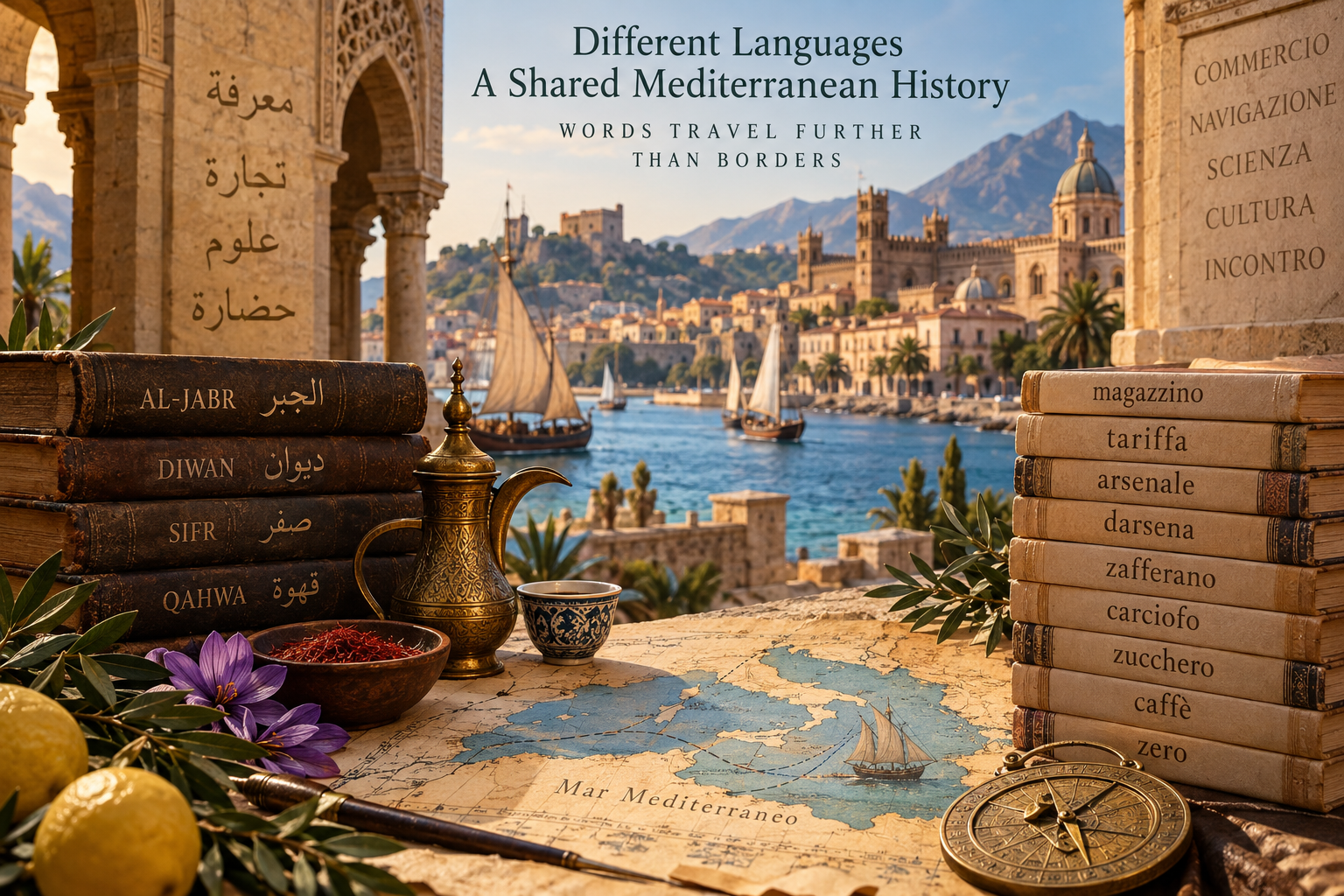
Arabic and Italian: How Centuries of Mediterranean Contact Shaped Both Languages
The Arabic influence on Italian is one of the most fascinating results of centuries of Mediterranean contact. Although Arabic and Italian belong to completely different language families, trade, conquest, scholarship, navigation, migration, and cultural exchange repeatedly brought their speakers into contact. From Sicily and southern Italy to Venice, Genoa, North Africa, and the eastern Mediterranean, this long relationship left a visible linguistic legacy.
Words such as magazzino, tariffa, arsenale, zafferano, and zero are so thoroughly Italian today that few speakers stop to consider the journeys behind them. Yet their histories lead us across the Mediterranean and, in many cases, into Arabic.
The exchange did not move in only one direction. Italian also left traces in Arabic-speaking communities, particularly in Mediterranean dialects such as Libyan Arabic.
The relationship between Arabic and Italian is therefore more than a collection of borrowed words. It is a linguistic record of more than a thousand years of Mediterranean history.
Two Languages from Different Worlds
Italian and Arabic are not genetically related languages.
Italian is a Romance language, developed primarily from the varieties of Latin spoken in the Italian peninsula. Arabic belongs to the Semitic branch of the Afro-Asiatic language family.
Their structures reflect this difference. Italian inherited much of its basic vocabulary and grammatical architecture from Latin, while Arabic famously organizes a large part of its vocabulary around consonantal roots and morphological patterns.
Yet languages do not need to be related in order to influence one another.
They need contact.
For centuries, the Mediterranean provided exactly that.
Rather than functioning simply as a boundary between Europe, North Africa, and the Middle East, the sea connected ports, markets, courts, universities, and commercial communities.
Venice, Genoa, Pisa, Palermo, Tunis, Tripoli, Alexandria, and cities of the eastern Mediterranean participated at different periods in overlapping networks of exchange.
People traveled through these networks.
Words traveled with them.
Arabic Influence on Italian: Where Did It Begin?
There was no single moment when Arabic began influencing Italian.
Arabic words entered the linguistic varieties of the Italian peninsula through several routes: political contact, commerce, navigation, travel, translation, and intermediary languages.
Linguist Wolfgang Schweickard, in his study of Italian-Arabic linguistic contact, identifies southern Italy as a particularly important historical contact zone and emphasizes that Arabic vocabulary reached Italian through multiple channels.
This distinction matters.
An Arabic-derived Italian word did not necessarily travel directly from an Arabic speaker into what we now call Standard Italian.
Some words first entered Sicilian or other regional varieties. Others passed through medieval Latin, Spanish, French, Turkish, or another Mediterranean language before reaching their modern Italian forms.
The history of Arabic influence on Italian is therefore not a straight line.
It is a network.
Arabic in Sicily and Southern Italy
Sicily occupies a special place in this history.
The Muslim conquest of Sicily began in 827, and Muslim political control expanded gradually across the island. The Norman conquest began in the eleventh century, and Noto, the last major Muslim stronghold, fell in 1091.
But political conquest did not instantly eliminate Arabic culture or the Arabic language.
Arabic remained important in Norman Sicily, particularly in administration and court culture. Under the Norman monarchy, documents could be produced in Latin, Greek, and Arabic. The royal administration also included an Arabic dīwān, reflecting the continuing importance of administrative traditions inherited from the previous period.
Sicily was therefore not simply a place where one civilization suddenly replaced another.
For a significant period, Latin, Greek, and Arabic traditions coexisted.
Their linguistic traces remain visible today.
Arabic Is Still Written Across the Map of Sicily
One of the most remarkable survivals of Arabic in Sicily is found not merely in dictionaries but on maps.
The Arabic word قلعة — qalʿa, meaning “fortress” or “citadel,” survives in Sicilian place names beginning with Calta- or related forms.
Examples include:
Caltanissetta
Calatafimi
Caltabellotta
The political world that produced these names disappeared centuries ago, but the names survived.
This illustrates something fundamental about language.
Empires can disappear faster than words.
A traveler can move through modern Sicily today and unknowingly pronounce fragments of medieval Arabic history.
Italian Words That Come from Arabic
The Arabic influence on Italian becomes particularly visible in vocabulary associated with commerce, agriculture, food, navigation, administration, and science.
Some examples are especially well documented.
Magazzino — مخزن
Italian magazzino, meaning “warehouse” or “storage place,” derives from Arabic مخازن — makhāzin, the plural of مخزن — makhzan, a place where something is stored.
The word is revealing because its journey did not end in Italy.
Related forms eventually entered other European languages. English magazine, for example, belongs to the same extended history.
The meanings changed as the word traveled, but the linguistic ancestry remained.
A modern European word can therefore preserve the memory of a medieval Arabic storeroom.
Tariffa — تعريفة
Italian tariffa derives from Arabic تعريفة — taʿrīfa, historically associated with notification or specification.
In Italian it developed into the familiar commercial meaning of a schedule or fixed list of prices, rates, or charges.
This is exactly the kind of vocabulary that commonly crosses linguistic borders.
Merchants trading across different languages require terminology for prices, taxes, measurements, goods, and payments.
Commercial necessity becomes linguistic exchange.
Dogana — ديوان
Italian dogana, meaning “customs office,” is historically connected with Arabic ديوان — dīwān, a word associated with registers, offices, and administration.
Its semantic journey is particularly interesting.
A term associated with administrative organization entered the Italian linguistic world and eventually developed into the modern word connected with customs and the regulation of goods crossing borders.
Borrowing, therefore, involved more than objects.
Institutions could carry words with them.
Arabic Words in Italian Maritime Vocabulary
The sea itself left Arabic traces in Italian.
Arsenale — دار الصناعة
Italian arsenale ultimately derives from Arabic دار الصناعة — dār al-ṣināʿa, literally a “house of manufacture” or workshop, particularly associated historically with naval production.
The Italian form has an important connection with Venetian usage.
The word underwent substantial phonetic transformation during its journey, but its Arabic ancestry remains identifiable.
The history fits the word perfectly.
Ports, ships, naval workshops, merchants, and sailors created exactly the environment in which specialized vocabulary could move between languages.
Darsena — دار الصناعة
Italian darsena, referring to a dock or protected inner harbor area, is also derived from forms connected with Arabic dār al-ṣināʿa, in this case particularly through Genoese.
This gives us a remarkable example.
Two Italian maritime words—arsenale and darsena—developed through different historical routes from forms connected with the same Arabic expression.
Arabic did not influence an abstract and uniform “Italian language” all at once.
Contact occurred in real cities.
Venice had one history.
Genoa had another.
Sicily had another.
Eventually, words born from these local encounters could become part of wider Italian vocabulary.
Arabic Influence on Italian Food and Agriculture
Agriculture and food provide another linguistic archive of Mediterranean exchange.
Carciofo — خرشوف
Italian carciofo, “artichoke,” derives from Arabic خرشوف — kharshūf.
This is not surprising historically.
Agricultural products and techniques often move together with their names. When a society encounters a new crop or a new way of cultivating it, borrowing the existing name can be easier than inventing a new one.
Zafferano — زعفران
Italian zafferano, “saffron,” derives from Arabic زعفران — zaʿfarān.
Even after centuries of phonological adaptation, the relationship between the two forms remains striking.
Limone and the Role of Arabic as an Intermediary
Italian limone is connected through Arabic līmūn, but its deeper history extends beyond Arabic into Persian and ultimately older Asian linguistic traditions.
This distinction is essential.
Not every word transmitted from Arabic to Italian was originally created in Arabic.
Arabic often served as an intermediary language, carrying words, products, scientific ideas, and commercial practices from other civilizations into Mediterranean Europe.
Arabic was therefore sometimes the source.
At other times, it was the bridge.
Zucchero: How a Word Crossed Civilizations
Italian zucchero, “sugar,” provides another good example.
Its Italian history passes through Arabic سكر — sukkar, but the deeper history of the word extends eastward and is ultimately connected with India.
It would therefore be imprecise simply to say that sugar is “an Arabic word.”
A more accurate statement is that Arabic played a crucial role in transmitting the word—and the commodity associated with it—into the Mediterranean linguistic world from which it entered Italian and other European languages.
Etymology often works this way.
A word may have more than one historical home.
From Arabic Qahwa to Italian Caffè
Few examples are more culturally interesting than coffee.
Today, coffee is deeply associated with Italian culture. Italian terms such as espresso, cappuccino, and latte have spread internationally.
Yet Italian caffè belongs to a linguistic chain that leads eastward.
The Italian word came through Turkish kahve, which derives from Arabic:
قهوة — qahwa
The journey is revealing:
Arabic qahwa → Turkish kahve → Italian caffè
Later, Italian coffee culture became globally influential, and Italian coffee terminology traveled outward into many other languages.
The direction of linguistic influence had changed.
Arabic contributed to the European history of the word for coffee.
Italy later contributed a new international vocabulary for ways of preparing and consuming it.
One drink became the carrier of several centuries of linguistic exchange.
Arabic and Italian in Mathematics and Science
The intellectual relationship between the Arabic-speaking world and Italy becomes particularly significant in mathematics.
One small Italian word tells an enormous historical story:
zero.
From صفر to Zero
Italian zero is historically connected with Arabic:
صفر — ṣifr
The transmission is particularly associated with Leonardo Fibonacci.
In his Liber Abaci, completed in 1202, Fibonacci used the medieval Latin form zephirum in connection with Arabic ṣifr. Through subsequent linguistic development, forms derived from this tradition eventually produced modern Italian zero.
The related Italian word cifra, meaning a digit or figure, also belongs to the historical development associated with Arabic ṣifr.
But another distinction is necessary here.
The decimal positional numeral system was not simply “invented by the Arabs.”
Its fundamental origins lie in India.
Arabic-speaking mathematicians adopted, studied, developed, and transmitted this mathematical tradition. It subsequently reached Latin Europe, where figures such as Fibonacci helped promote its use.
The historical chain is therefore more interesting than a simple claim of invention:
India → Arabic mathematical scholarship → medieval Europe
Knowledge, like vocabulary, traveled through civilizations.
Algebra and the Arabic Article Hidden in European Languages
Another mathematical word preserves Arabic even more visibly:
algebra.
Italian algebra, like English algebra, derives from Arabic:
الجبر — al-jabr
The term is famously associated with the mathematical work of Muḥammad ibn Mūsā al-Khwārizmī.
Something particularly interesting happened during the borrowing process.
In Arabic, الـ — al- is simply the definite article: “the.”
But when the word entered European linguistic traditions, the article remained attached to the noun.
As a result, a small piece of Arabic grammar became permanently embedded in an international scientific term.
Millions of people who have never studied Arabic use an Arabic definite article whenever they say algebra.
Did Italian Influence Arabic Too?
Yes—but the relationship must be described carefully.
Italian did influence Arabic-speaking communities, particularly around the Mediterranean, but its impact was neither geographically uniform nor historically equivalent to the older Arabic influence on Italian.
It would be misleading to claim that Italian substantially reshaped Arabic as a whole.
Instead, the strongest evidence appears in particular dialects and contact zones.
The clearest example is Libya.
Italian Loanwords in Libyan Arabic
Contact between Italian and Libyan Arabic intensified dramatically during the nineteenth and twentieth centuries, particularly following the beginning of Italian colonial rule in Libya in 1911.
Linguist Luca D’Anna has documented the substantial Italian lexical presence in Libyan Arabic and estimates approximately 700 Italian lexical items, while noting that the ultimate Romance origin of some individual items may require caution.
Italian-derived vocabulary is particularly noticeable in semantic fields associated with modern material culture, including mechanics, household objects, cuisine, clothing, and sport.
This influence differs significantly from the medieval Arabic influence on Italian.
It is later.
It is geographically concentrated.
And it primarily affects dialectal vocabulary rather than the fundamental structure of Standard Arabic.
Nevertheless, it demonstrates that linguistic exchange across the Mediterranean never moved permanently in one direction.
Historical circumstances changed.
The direction of borrowing changed with them.
Italian as a Mediterranean Contact Language
Italian influence on Arabic cannot be explained only through colonial Libya.
Italian and regional Italian varieties had already circulated throughout the Mediterranean for centuries.
Venetian, Genoese, and other Italian-speaking commercial communities maintained extensive maritime networks. Italian varieties consequently became important contact languages in certain commercial, diplomatic, and maritime environments.
Recent scholarship on Italian in the Mediterranean emphasizes its historical international role, particularly in seafaring and commerce.
This created additional opportunities for Italian vocabulary to enter Arabic-speaking coastal communities.
Once again, geography mattered.
The Mediterranean connected languages because it connected people.
Influence Does Not Mean Linguistic Kinship
Despite centuries of contact, Arabic and Italian remain structurally very different languages.
Italian remains fundamentally Romance.
Arabic remains fundamentally Semitic.
Most of the historical influence discussed here concerns vocabulary rather than the core grammatical architecture of either language.
This is normal.
A language can borrow hundreds or thousands of words without changing its genealogical identity.
English, for example, remains a Germanic language despite the enormous proportion of vocabulary it has borrowed from French and Latin.
Likewise, Arabic loanwords do not make Italian a Semitic language.
Italian loanwords do not make Libyan Arabic a Romance language.
Vocabulary records contact.
Grammar more often preserves ancestry.
Not Every Similar Word Has an Arabic Origin
The popularity of Arabic-European etymology has created a significant problem online: false etymologies.
Lists frequently circulate claiming that hundreds or thousands of Italian, Spanish, or English words are Arabic simply because they resemble Arabic words.
Historical linguistics requires much stronger evidence.
Researchers examine early written forms, chronological evidence, regular sound changes, semantic development, geographical contact, and possible intermediary languages.
Sound similarity alone proves very little.
The history of citrus terminology illustrates the problem particularly well.
Some words passed through Persian, Arabic, Mediterranean Romance languages, and other linguistic environments over long periods.
Saying simply “this Italian word is Arabic” can therefore erase half of its history.
Good etymology asks two separate questions:
From which language did Italian immediately receive the word?
and:
Where did the word ultimately originate?
The answers are not always the same.
What These Words Actually Tell Us
Consider a small selection of modern Italian vocabulary:
magazzino ← Arabic makhāzin
tariffa ← Arabic taʿrīfa
dogana ← Arabic dīwān
carciofo ← Arabic kharshūf
zafferano ← Arabic zaʿfarān
darsena ← Arabic dār al-ṣināʿa
arsenale ← forms connected with the same Arabic expression
zero / cifra ← Arabic ṣifr
These are not merely curiosities for etymological dictionaries.
Together, they describe a civilization in motion.
Magazzino and tariffa remember commerce.
Dogana remembers administration.
Arsenale and darsena remember ships and ports.
Carciofo and zafferano remember agriculture and food.
Zero and cifra remember the transmission of mathematical knowledge.
A vocabulary list becomes a historical document.
The Most Interesting Question Is Not Who Borrowed More
It is tempting to turn linguistic history into a competition.
How many Italian words came from Arabic?
How many Arabic words came from Italian?
Which civilization influenced the other more?
These questions can be useful, but they can also obscure the larger story.
Languages borrow vocabulary when their speakers exchange things that matter.
Arabic influence on Italian reflects historical periods in which Arabic-speaking societies occupied important positions in Mediterranean commerce, agriculture, navigation, administration, and scholarship.
Later Italian influence on Arabic varieties reflects different historical circumstances involving maritime commerce, technological change, migration, political influence, and—in Libya—colonial rule.
The balance changed because history changed.
Language followed.
Arabic and Italian: A Shared Mediterranean History
Arabic and Italian are not sister languages.
But they have been historical neighbors for more than a millennium.
They met in Sicily and southern Italy, in Venetian and Genoese commerce, in North African ports, aboard Mediterranean ships, in administrative offices, in scientific texts, and eventually in the colonial and postcolonial societies of the modern Mediterranean.
The exchange was neither simple nor equal.
Arabic exerted an older and broader lexical influence on Italian, while Italian later left significant traces in particular Arabic varieties, most notably Libyan Arabic.
Sometimes Arabic was the original source of a word.
Sometimes it served as an intermediary carrying a Persian, Indian, or other term westward.
Sometimes Italian borrowed from Arabic.
Sometimes Arabic-speaking communities borrowed from Italian.
And sometimes a borrowed word became so completely integrated into its new language that its speakers forgot it had ever been foreign.
That may be the most revealing lesson of all.
Languages remember human contact long after political borders, empires, and trading systems disappear.
When an Italian speaker says magazzino, tariffa, arsenale, zafferano, cifra, or zero, fragments of the Arabic-speaking Mediterranean remain present in everyday speech.
And when Italian-derived vocabulary appears in Libyan Arabic and other Mediterranean contact varieties, it preserves a different and later chapter of the same story.
Arabic and Italian may be structurally distant.
Historically, however, the Mediterranean kept bringing them together.
Selected References
Treccani — Vocabolario della lingua italiana and Enciclopedia Italiana. Etymological entries for magazzino, tariffa, dogana, arsenale, darsena, carciofo, zafferano, zucchero, limone, caffè, cifra, and zero.
Johns, Jeremy. Arabic Administration in Norman Sicily: The Royal Dīwān. Cambridge University Press, 2002.
Schweickard, Wolfgang. “Italian and Arabic.” Lexicographica: International Annual for Lexicography, vol. 33, pp. 121–184.
D’Anna, Luca. “Phonetical and Morphological Remarks on the Adaptation of Italian Loanwords in Libyan Arabic.” In Arabic in Contact, John Benjamins, 2018, pp. 171–187.
Baglioni, Daniele. “Italian in the Mediterranean Area.” In The Oxford Handbook of the Italian Language. Oxford University Press.